
Choosing the right gas is an important part of designing and operating a reliable beverage dispensing system. The gas in a system can affect carbonation, pressure, pour quality, product consistency, and how efficiently beverages move from their containers to the dispensing point.
For commercial soda and beverage systems, the most common gases are carbon dioxide, nitrogen, and blends of the two. Each gas has different properties and is suited to different applications. Understanding those differences can help a business ask better questions when planning a new system, replacing equipment, or troubleshooting inconsistent dispensing.
What Does Gas Do in a Beverage System?
Gas generally performs one of two primary jobs in a beverage dispensing setup: it adds carbonation to a beverage, or it provides pressure to move the beverage through the system. In some applications, the same gas does both jobs.
Carbonated soft drinks contain dissolved carbon dioxide. A soda system uses gas pressure to move syrup and water through the equipment, while the system’s carbonation process gives the finished beverage its familiar level of sparkle. Gas pressure also helps maintain a steady flow from the beverage source to the dispensing equipment.
Gas does not simply push product through a line in an interchangeable way. The type of gas, pressure setting, temperature, line length, fittings, and equipment design all work together. A gas choice that is appropriate for one beverage program may not be the best fit for another.
Carbon Dioxide: The Main Gas for Carbonation
Carbon dioxide, commonly called CO2, is the primary gas associated with carbonated beverages. It dissolves into water and other liquids under pressure, producing the carbonation expected in soda and other sparkling drinks.
How CO2 is used
- Carbonating water in soda fountain systems
- Maintaining carbonation in finished beverages
- Providing pressure to move carbonated beverages through dispensing lines
- Supporting beverage systems that require a consistent supply of carbonated water
In a commercial soda system, CO2 may be connected to equipment that combines water, syrup, and carbonation before the drink reaches the dispenser. The system must be set up so that the gas supply, water supply, syrup delivery, and dispensing components work together.
Too little pressure may contribute to weak flow or poor carbonation. Excessive or improperly regulated pressure can create other performance problems, including excessive foaming, unstable dispensing, or unnecessary stress on system components. The correct settings depend on the equipment and beverage application rather than on a single universal number.
Nitrogen: A Gas for Texture and Smooth Dispensing
Nitrogen, or N2, is another beverage gas used in commercial dispensing. Nitrogen behaves differently from CO2 because it is less soluble in liquid. That property can contribute to a smoother mouthfeel and a different pour characteristic when the system and beverage are designed for nitrogen service.
Nitrogen is often associated with beverages that are intended to have a softer, creamier texture rather than a sharp, highly carbonated profile. It can also be used in beverage systems where maintaining the intended product characteristics requires a gas with lower solubility than carbon dioxide.
Why nitrogen service requires proper equipment
Nitrogen applications are not simply a matter of replacing one cylinder with another. Gas regulators, connectors, dispensing hardware, pressure requirements, and product characteristics all need to be considered. A system designed for a particular beverage should be matched with compatible components and appropriate operating settings.
Using the wrong gas or an unsuitable setup can change the beverage’s texture, affect dispensing speed, or make it difficult to maintain consistent pours. Equipment selection is especially important when a business is adding nitrogen service to an existing beverage program.
Mixed Beverage Gas: Combining CO2 and Nitrogen
Some beverage systems use a blended gas containing both carbon dioxide and nitrogen. These blends are often selected when an operator needs a balance between carbonation and controlled dispensing pressure.
A mixed gas can help limit the amount of carbon dioxide introduced into a beverage while still providing the pressure needed to move product through the system. The specific blend should be selected according to the beverage, equipment, distance between the product and dispenser, and required serving characteristics.
Mixed gas is not one standardized product for every application. Different beverages and system designs may call for different proportions of CO2 and nitrogen. A qualified beverage gas provider or system professional can help determine whether a blend is appropriate and how it should be regulated.
Compressed Air and Beverage Systems
Compressed air may be used for certain equipment functions, but it is not a universal substitute for beverage gases. Ordinary shop air can contain moisture, oil, particles, or other contaminants that are not appropriate for direct contact with beverages.
For any application in which gas could contact a beverage, the gas source and system components must be appropriate for that use. Businesses should not connect an unapproved air compressor to a beverage line simply because it can produce pressure. The correct approach depends on the equipment design and the manufacturer’s requirements.
How to Choose the Right Type of Gas
Gas selection starts with the beverage and the dispensing objective. Before choosing a gas, consider the following questions:
- Is the beverage carbonated? Carbonated products commonly require CO2 for carbonation and pressure management.
- What texture and pour characteristics are expected? Nitrogen or a blend may be appropriate when a smoother profile or different dispensing behavior is desired.
- How far must the beverage travel? Long-draw systems can have different pressure and equipment requirements than a short connection.
- What equipment is already installed? Regulators, connectors, pumps, tubing, dispensers, and other components must be compatible with the selected gas.
- How many beverages are being served? A larger beverage program may require more careful planning for gas storage, distribution, and changeover.
- What does the equipment manufacturer specify? Manufacturer guidance should be part of the system design and operating process.
The goal is not simply to select the strongest or highest-pressure gas supply. The goal is to provide the right gas at the right pressure through equipment that is designed for the application.
Gas Cylinders, Regulators, and Distribution Components
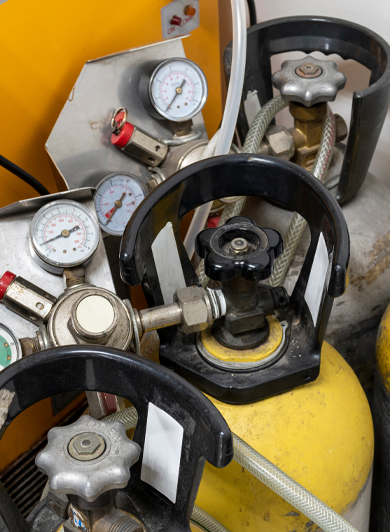
A beverage gas system includes more than a cylinder. The supply may also include regulators, shutoff valves, gas lines, connectors, manifolds, and monitoring equipment. Each part contributes to safe and consistent operation.
Regulators reduce and control cylinder pressure so the system receives a usable operating pressure. A separate regulator or pressure-control arrangement may be needed for different beverage circuits or applications. Gas lines and fittings must be compatible with the intended gas and installed so that connections remain secure.
Storage and handling are also important. Gas cylinders should be secured properly, protected from damage, and handled according to applicable safety requirements. Staff should know how to identify cylinders, recognize a low supply, close a shutoff valve when necessary, and report suspected leaks or equipment problems.
Signs of a Gas or Dispensing Problem
Inconsistent beverage quality does not always mean the gas itself is defective. The cause may be an empty or nearly empty cylinder, a regulator issue, a loose connection, an obstructed line, incorrect pressure, temperature problems, or equipment that needs cleaning or service.
Common signs that deserve attention include:
- Unexpectedly flat or over-carbonated beverages
- Excessive foaming or slow pours
- Pressure that changes without an obvious adjustment
- A hissing sound near a cylinder, regulator, or connection
- Gas being consumed more quickly than expected
- Different dispensing results from otherwise similar beverage outlets
If a leak is suspected, staff should follow the business’s safety procedures and avoid attempting repairs beyond their training. Gas equipment should be inspected by a qualified professional when the cause is not clear.
Why Professional System Planning Matters
A soda and gas system should be planned around the complete beverage program rather than treated as a collection of isolated parts. Product selection, gas type, equipment layout, dispensing locations, line routing, pressure control, and maintenance all affect the final result.
Professional installation can help ensure that the gas supply is matched to the beverage equipment and that the system is arranged for practical operation. Ongoing service can also help identify pressure, connection, or component problems before they disrupt beverage service.
Perfect Pour Draft Inc provides soda and gas systems for bars, restaurants, and commercial venues. Its services include CO2, nitrogen, and beverage gas distribution, along with soda system solutions and related dispensing equipment.
Understanding Gas Is the First Step
CO2, nitrogen, and blended beverage gases each have a role in commercial dispensing. CO2 is central to carbonation, nitrogen can support a smoother beverage profile and distinctive dispensing characteristics, and blended gases can provide a balance of carbonation and pressure control.
The best choice depends on the beverage, equipment, system layout, and operating goals. When those factors are evaluated together, a business can build a beverage system that delivers more consistent results and is easier to manage.
Need help selecting or servicing a beverage gas system? Contact Perfect Pour Draft Inc at 1-914-447-4926 to discuss your soda and gas system needs.